Dza Hūṃ Baṃ Hoḥ and the Four Gate Goddesses
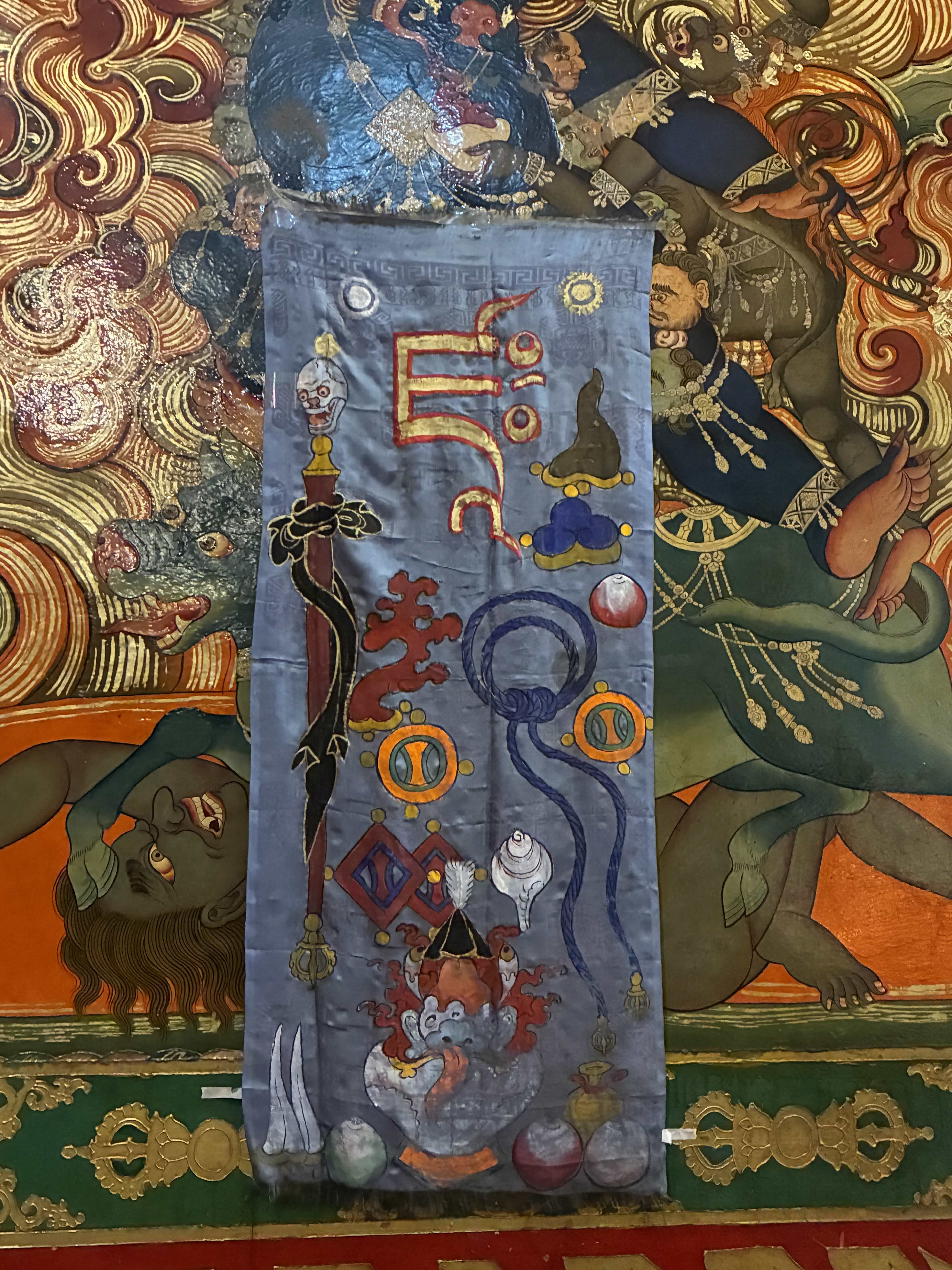
A small Tibetan syllable can be surprisingly dense. The sign I was trying to understand was not an ordinary Tibetan word, but a tantric syllable: ཛཿ, usually read in Tibetan pronunciation as dza. In Sanskritized transliteration it is jaḥ. The sign on the right, ཿ, is the Tibetan rnam bcad, corresponding to the Sanskrit visarga, the final breath-like sound written as ḥ.
This syllable often appears as part of the fourfold formula
ཛ་ཧཱུྃ་བཾ་ཧོཿ
dza hūṃ baṃ hoḥ
or, in a more Sanskritized spelling, jaḥ hūṃ vaṃ hoḥ.
This is not a sentence in the ordinary grammatical sense. It is a ritual formula. Its force is performative rather than descriptive: it does something inside the logic of the rite. In many Vajrayāna contexts it is used in connection with invitation, attraction, entrance, binding, and stabilization of a wisdom presence.
A rough functional translation would be:
Come. Enter. Be joined. Be established.
This should not be understood as a literal dictionary translation. It is closer to an explanation of the ritual movement of the four syllables.
The first syllable, dza / jaḥ, is especially important. It is associated with attraction or summoning. The image is not a polite invitation but a hook: something is caught and drawn into the ritual space. This is why the syllable is connected with the iron hook. In some explanations of the formula, dza hooks or attracts the wisdom being; hūṃ brings it in; baṃ binds or unites it; and hoḥ confirms, delights, or seals the presence.
The same formula is also explained through the four gate goddesses of a mandala. These goddesses are not merely decorative figures standing at the doors. They are the living functions of the mandala’s thresholds.
In a common explanation, the four syllables become four goddesses at the four gates:
- dza / jaḥ goes to the eastern gate and becomes a white goddess holding an iron hook.
- hūṃ goes to the southern gate and becomes a yellow goddess holding a lasso.
- baṃ / vaṃ goes to the western gate and becomes a red goddess holding an iron chain.
- hoḥ goes to the northern gate and becomes a green goddess holding a bell.
The objects are the key. The hook attracts. The lasso catches and holds. The chain binds inseparably. The bell proclaims, seals, awakens, or completes. The four gate goddesses therefore mark the transition from outside to inside, from absence to presence, from separation to ritual union.
This also explains why they are placed at the gates. A mandala is not just a diagram. It is a consecrated architecture of awakened space. The gate is the place of passage. To enter a mandala is not simply to walk through a door; it is to cross from ordinary perception into a purified symbolic world. The gate goddesses govern that crossing.
There is another point which can look strange to a modern viewer: these goddesses, or closely related tantric female figures, are sometimes shown naked, semi-naked, animal-headed, dancing, wrathful, or adorned with bone ornaments. This should not be read as ordinary erotic decoration. In tantric Buddhist iconography, nakedness often means the absence of coverings: no social mask, no conventional shame, no conceptual clothing. It is a visual way of saying that awakened wisdom is not dressed in the habits of ordinary dualistic thinking.
The same applies to the more frightening details of tantric art: skulls, charnel-ground ornaments, flames, animal faces, knives, hooks, chains. They are not accidental grotesque additions. They belong to a symbolic language in which death, desire, fear, and attachment are not ignored but transformed. A wrathful or naked figure does not necessarily represent violence or sexuality in the ordinary sense. It can represent a direct, unhidden, and uncompromising form of wisdom.
So dza hūṃ baṃ hoḥ can be read as a very compact ritual drama:
- the wisdom presence is summoned;
- it enters the mandala;
- it is bound inseparably with the visualized form;
- the union is sealed and made effective.
The four goddesses are the guardians and operators of this drama. They stand at the thresholds because the threshold is exactly where transformation happens.
Sources and further reading:
- Rigpa Wiki: Mantra of the Four Gate Keepers
- Rigpa Wiki: Four female gatekeepers
- 84000: The Tantra of the Blue-Clad Blessed Vajrapāṇi
- Unicode names list for Tibetan: U+0F7F as visarga
- Project Himalayan Art: Visual Symbols of Buddhist Art
- Rubin Museum: A Viewer’s Guide to Wrathful Iconography in Himalayan Art